Best AI Customer Service Agents for Shopify and WooCommerce
Compare the best AI customer service agents for Shopify and WooCommerce stores. See which tools actually resolve tickets — not just answer questions.

Ezra Klijnsma
Building AI support agents for online stores

Most AI chatbots answer questions. The good ones resolve tickets. There's a real difference: one links to your return policy, the other creates the return label. This shortlist covers nine AI customer service agents built for Shopify and WooCommerce stores, ranked by what they actually do when a shopper hits send.
1. Nousu — AI Agent That Resolves Tickets End to End
Nousu is built for Shopify and WooCommerce stores that want tickets handled, not just answered. Connect your store, set the rules, and the AI agent reads live order data, replies in your brand voice, and closes the ticket. No overage fees. No per-conversation billing. One flat monthly price per store.
Where most tools stop at "here's your tracking number," Nousu goes further. It states delivery windows, creates return labels, processes refunds within your set guardrails, and updates shipping addresses , all from inside the same chat or email thread. WISMO queries ("where is my order?") make up 30, 50% of most ecommerce queues. Nousu handles them end to end, so your team only sees what genuinely needs a human decision.
Setup takes about a day. Connect WooCommerce or Shopify, drop in the live chat widget, add your policy docs to the knowledge base, and the agent starts working. You control how much autonomy it has. Start in copilot mode , the AI drafts, a human approves with one click. Once you trust it on routine topics like order status and standard returns, flip those to autopilot. High-stakes actions like refunds follow your rules, not the AI's judgment.
Pricing runs in tiers: a Start plan for roughly 150 conversations per month, Core for around 500, and Plus for higher-volume stores with multiple AI agents. Your busiest month costs the same as your slowest , there's no growth tax when Black Friday hits. That's the structural difference between Nousu and per-outcome or per-conversation billing.
Nousu is also the only agent in this comparison that lists both Shopify and WooCommerce as native integrations. If you run WooCommerce, most other tools on this list either don't connect or require a custom connector that adds setup time and cost.
The honest caveat: for highly nuanced or escalation-heavy queries , disputed chargebacks, complex fraud claims , Nousu hands off to a human with full context rather than attempting a resolution. That's the right call, but it means you still need someone available for edge cases.
2. Gorgias — Shopify-Native Helpdesk With Ticket-Based Pricing
Gorgias is a helpdesk built around Shopify merchants, and it shows. The AI agent can track orders, process returns, update shipping addresses, apply discounts, and handle refunds , all inside the ticket view, without switching tools.
The action depth is genuinely strong for Shopify stores. Gorgias reads live order data and executes changes directly, which is what separates it from FAQ-only bots. For a store doing serious ticket volume on Shopify, it's one of the most capable options available.
Pricing is ticket-based, which matters when you're evaluating costs. Plans start at $10/month for a Starter tier (up to 50 tickets), scaling up through higher tiers with overage charges for additional volume. That model works well at steady volume, but during a peak like Black Friday, when your queue triples, those overage charges add up fast.
WooCommerce support is limited or requires integration work. If your store runs on WooCommerce, Gorgias is probably not the right fit. And if you're not already on the Gorgias helpdesk, the AI agent won't install into Zendesk or Kustomer , it's locked to the Gorgias platform.
Choose Gorgias if you're Shopify-only, already using or open to adopting the Gorgias helpdesk, and your ticket volume stays predictable enough that metered pricing doesn't scare you. If volume spikes unpredictably, the flat-rate alternative is worth the comparison before you commit.
3. Fin (Intercom) — Per-Resolution Billing With Shopify Connectors
Fin is Intercom's AI agent, and it's one of the more capable tools in terms of raw resolution quality. Intercom publishes resolution rate figures for ecommerce deployments in the 70–84% range, though results vary by ticket mix and configuration.
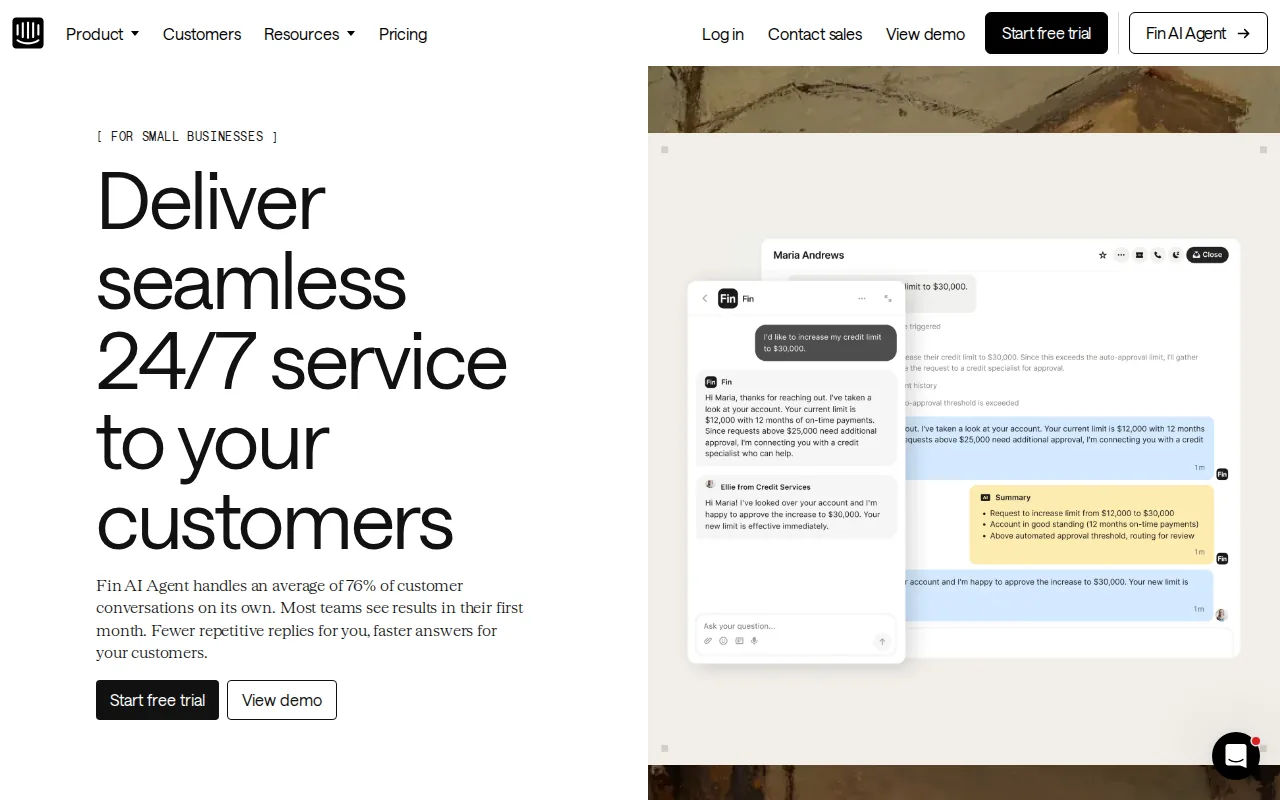
On Shopify, Fin can look up order status, process refunds, handle cancellations, and manage some order modifications when wired to your commerce stack through custom connectors. That last part matters: Shopify-specific workflows require configuration. Fin isn't ecommerce-native by default — it's a general-purpose AI agent with ecommerce connectors added on top.
Pricing is outcome-based at $0.99 per resolved conversation, with Intercom suite seats starting from $29/month. You only pay when the AI fully resolves the ticket, which sounds appealing until your volume spikes and the per-resolution bill scales with it. A high-traffic week can produce a bill you didn't plan for.
The 14-day free trial gives you enough time to test resolution quality against your actual ticket mix. That's the right way to evaluate Fin — run it on real tickets, not a demo queue.
WooCommerce support is limited. Fin works best inside Intercom's own suite, so merchants running a different helpdesk will face integration complexity. If you're already an Intercom shop and primarily on Shopify, Fin is a serious option. If you need WooCommerce coverage or want cost certainty, it's not the strongest fit.
5. Yuma AI — Performance-Based Agent for Shopify and Gorgias Users
Yuma AI targets high-volume DTC brands on Shopify that already run Gorgias, Zendesk, Kustomer, or Re:amaze. Rather than replacing your helpdesk, it sits on top as an automation layer , reading live order data, checking policies, and taking action inside the existing ticket thread.
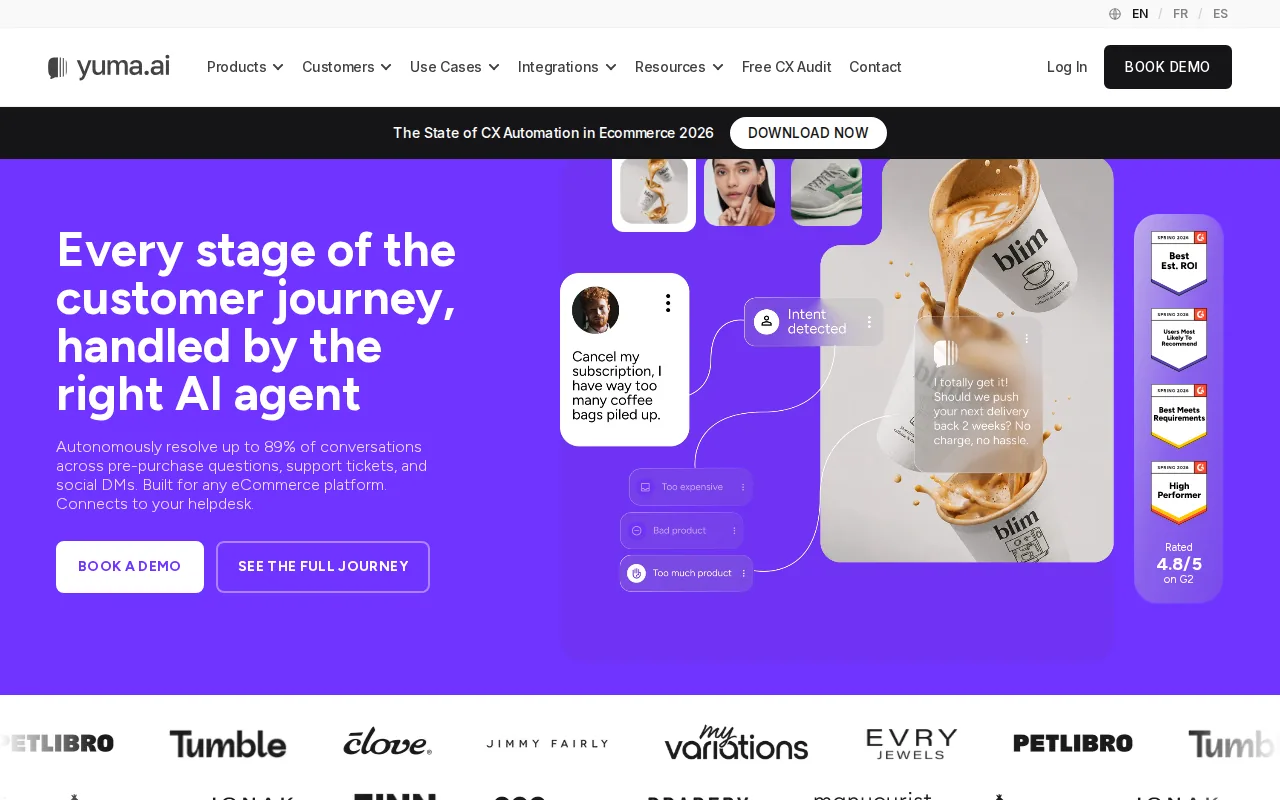
The action surface is wide. Yuma handles refund processing, exchange management, order edits, subscription changes, and WISMO queries, all without rebuilding your existing helpdesk logic. It installs into Gorgias with a single click and pulls your existing macros, tags, and routing rules into its reasoning layer. For teams standardized on Gorgias + Shopify, that's a meaningful advantage , you don't restart from zero.
Performance-based pricing means you pay for tickets the AI fully resolves, with Yuma claiming a 100% ROI guarantee on every contract. The 30-day free trial uses your actual ticket data, which is the right way to validate any resolution claim.
The stack complexity is worth flagging. If you use Shopify plus Gorgias plus Yuma, you're paying for three platforms. That overhead makes sense at high volume where the labor savings justify it. For smaller stores, it's likely overkill.
Yuma supports BigCommerce and connects to Recharge and Klaviyo, which gives subscription-heavy brands more use. WooCommerce isn't in their primary integration list. If you're on WooCommerce, Yuma probably isn't your path.
6. Zowie — Returns and Refunds Automation for Shopify Merchants
Zowie focuses on automating the most action-heavy part of ecommerce support: returns, refunds, and order modifications. For Shopify merchants where those ticket types dominate the queue, it's a targeted option.
The platform uses consumption-based pricing without publishing specific rates publicly. That makes it hard to budget without going through a sales conversation, which is a friction point for merchants who want to compare costs quickly.
Zowie's Agent Connect layer is designed for larger operations that run multiple AI agents , in-house builds, third-party tools, and Zowie together , with a single orchestration layer routing across all of them. The audit trail holds across agent handoffs, which matters for compliance-focused teams. That's enterprise infrastructure, and the setup reflects it.
For a mid-size Shopify merchant with a straightforward returns problem, Zowie works. For a small store, the setup investment and opaque pricing make simpler tools easier to start with. Zowie is SOC 2, GDPR, and EU AI Act compliant , which matters if you sell into regulated markets.
WooCommerce isn't listed as a primary integration. Shopify is the target platform here.
7. Ada — Per-Conversation Billing With Broad Channel Coverage
Ada is a cross-industry AI platform with wide channel coverage: chat, email, social, and voice. For Shopify merchants who need support across multiple touchpoints, that breadth is the pitch.
The billing model is per conversation, not per resolution. You pay for every conversation the AI has, including ones it escalates to a human without fully resolving. Ada doesn't publish pricing on its site, so costs should be verified directly with their team.
Ada's "Reasoning Engine" handles multi-step workflows and supports structured playbooks for complex scenarios. It integrates with Shopify for order lookups and basic actions. Like most general-purpose platforms, ecommerce-specific flows require configuration rather than working out of the box.
The honest reality: if the AI escalates to a human, you still paid for that conversation. At high volume with a meaningful escalation rate, those costs add up in ways that are hard to predict. For merchants who want cost certainty, the per-conversation model is the thing to pressure-test before signing.
Ada makes sense for larger brands with diverse support channels that need voice and social handled alongside chat. It's less suited to a focused ecommerce operation where the ticket mix is predictable and WooCommerce support matters.
8. Zendesk — General-Purpose Helpdesk Adapted for Shopify Stores
Zendesk is a mature enterprise helpdesk suite with a Shopify integration. It handles ticket routing, multi-agent workflows, SLA tracking, and reporting at a depth that few platforms match. For support teams managing complex operations across multiple brands or regions, it's a proven platform.
The ecommerce caveat is real: Zendesk is general-purpose, not ecommerce-native. Shopify-specific workflows , automated order updates, return processing, refund execution , require configuration. You're not getting those flows out of the box. Smaller and mid-size Shopify stores often find the setup heavier than the ticket volume justifies. For a full side-by-side of that tradeoff, the Nousu vs Zendesk comparison for AI customer service breaks down where each fits.
Pricing starts at €55 per agent per month for Suite Team (billed annually). Add the AI Copilot and that's another €50 per agent per month. A three-person support team paying for both features is looking at over €3,000 per year before any add-ons. That's a reasonable investment for a large operation. For a small Shopify store, it may be more infrastructure than the ticket queue demands.
WooCommerce integration exists but requires setup work. Zendesk isn't the tool you reach for when you want to be live in a day , it's the tool you build into a broader support operation over time.
9. Shopify Inbox — Free Baseline for Stores Just Getting Started
Shopify Inbox is free, native, and live in minutes. Every Shopify plan includes it. For a store doing 20 orders a week with a manageable question load, it's genuinely hard to beat at the price , because the price is zero.
The limits are real and worth understanding. Inbox is a chat tool, not a support system. The AI drafts replies using Shopify Magic, but a human still reads and sends every message. Every conversation, no matter how repetitive, lands on your team. A WISMO query and a complicated dispute get the same treatment: someone handles them manually.
According to Shopify's own data, 70% of Inbox conversations happen with customers mid-purchase, making it more of a sales assist tool than a support resolution tool. That's actually a strength for pre-purchase questions , it converts browsers. It's a gap for post-purchase support.
Email isn't a real channel inside Inbox. It captures addresses when you're offline for follow-up, but there's no email ticketing, threading, or automation. For most stores, email is where the heavier support lives. Leaving that workload entirely manual is fine at low volume, painful at scale.
Use Shopify Inbox to start. Switch when your team spends meaningful time each week typing the same answers to the same questions. That's the signal , not a vanity metric, just wasted hours.
Head-to-Head Comparison: Features, Pricing Model, and Platform Fit
The table below covers the nine tools on the dimensions that matter most for ecommerce store owners choosing between them. Pricing reflects publicly listed figures as of July 2026 , verify directly with vendors before signing, as models change.
The pattern across this list is clear. Tools that charge per outcome or per conversation create unpredictable costs during traffic spikes. Intercom's own resolution rate figures show this dynamic clearly across a broad customer base. Flat-rate pricing , like Nousu's model , means your Black Friday queue costs the same to handle as a slow Tuesday in February. For merchants who want to automate ecommerce operations at scale without a billing surprise after every campaign, that predictability is the deciding factor.
How to Choose the Right AI Agent for Your Store
Before you evaluate any tool on this list, answer three questions about your store.
- What platform are you on? WooCommerce merchants have far fewer options than Shopify merchants. Nousu and Tidio are the only tools here with native WooCommerce support. Everyone else is Shopify-first.
- Do you need answers or actions? If your biggest ticket types are WISMO, returns, and cancellations, you need an agent that executes , not one that explains. Tools like Shopify Inbox and Tidio answer questions. Tools like Nousu, Gorgias, and Fin actually do the thing.
- Can you predict your ticket volume? Per-outcome and per-conversation billing works if your volume is steady. If it spikes at Black Friday or during a campaign, metered pricing gets expensive fast. Flat-rate pricing removes that anxiety entirely.
A note on setup time: most vendors in this category claim fast deployment, but the data is thin. The tools that actually publish setup times , Tidio, Shopify Inbox, and Nousu , all claim minutes to a day. For the others, assume at least a week of configuration before you're live on real tickets. If you're choosing a platform to compare options like these, understanding platform differences between Shopify and WooCommerce matters before you lock in on an AI agent that only supports one of them.
Run any tool on your real historical tickets before you commit. Not a demo queue. Your actual mix of WISMO, return requests, and order edits. That test tells you more than any vendor benchmark.
FAQ
What's the difference between an AI chatbot and an AI customer service agent for ecommerce?
An AI chatbot looks up answers in a knowledge base and replies. An AI agent does that and takes action , pulling live order data, creating return labels, processing refunds, or editing orders inside the ticket thread. For ecommerce stores, the distinction matters: chatbots handle questions, agents handle tickets. If your queue is full of WISMO and return requests, you need an agent, not a chatbot.
Which AI support tools actually work with WooCommerce, not just Shopify?
Most AI customer service tools on the market focus on Shopify and treat WooCommerce as an afterthought or don't support it at all. Nousu and Tidio are the two options in this comparison with native WooCommerce integrations. Nousu goes further , it resolves tickets end to end on WooCommerce, not just answers FAQ questions. If you run WooCommerce, check integration depth carefully before trialing any tool.
How do I avoid surprise bills during Black Friday with an AI support tool?
Per-outcome and per-conversation billing means your costs scale with traffic. During a sale event when ticket volume triples, a per-resolution model produces a very different bill than a flat monthly plan. The cleanest solution is a flat monthly tier , your busiest month costs the same as your slowest. Before signing any metered plan, calculate your peak-month volume and price it out. The difference is often significant.
Can an AI agent process refunds and returns automatically on Shopify?
Yes, several tools do this , but the degree of autonomy varies. Nousu, Gorgias, Fin, and Yuma AI can all execute returns and refunds on Shopify within merchant-set rules. The key question is control: can you cap refund amounts, require approval above a threshold, and review the AI's decisions? A good AI agent lets you set those guardrails rather than acting without limits. Human oversight in automated decision-making remains standard practice for high-stakes actions , and that applies here too.
How long does it take to set up an AI customer service agent for a Shopify store?
The fastest tools go live in under a day , connect the store, upload your policy docs, activate the chat widget. Nousu, Tidio, and Shopify Inbox all fall in that range. Gorgias is quick for Shopify merchants already on the platform. Zendesk and enterprise-tier tools can take weeks or months to configure properly. If speed to live matters, filter your shortlist to tools that publish their setup time and skip the ones that require a custom implementation.
Is Shopify Inbox good enough for a growing store?
Shopify Inbox is excellent for stores with low ticket volume and simple questions. It's free, native, and live in minutes. The ceiling appears quickly: every conversation still requires a human to type and send, there's no email ticketing, and it can't execute order changes. Once your team spends hours each week handling the same WISMO and return questions, you've outgrown it. The upgrade decision isn't about features , it's about how many hours your team loses to repetition each week.
Conclusion
If you run a Shopify or WooCommerce store and your ticket queue is full of order status checks and return requests, the tools above cover your options honestly. For most small to mid-size ecommerce merchants , especially those on WooCommerce , Nousu is worth trialing first: flat monthly pricing, no overage surprises, and an agent that actually resolves tickets rather than deflecting them. Start a 14-day free trial of Nousu's AI customer service for ecommerce and run it against your real ticket mix before committing to anything.